
Choose a ring that fits the intended finger and measure the inside diameter edge to edge.
Do not measure the outside edge; that includes the metal thickness.Best for turning a raw millimeter measurement into a practical ring size.
Ring Size Calculator
Enter inside diameter or circumference to find the closest ring size across major regional systems. It is designed for fast checks when a full printable gauge is not practical.
Measure and get a size suggestion
Use your own measurements to find the closest reference row, then confirm with the brand chart.
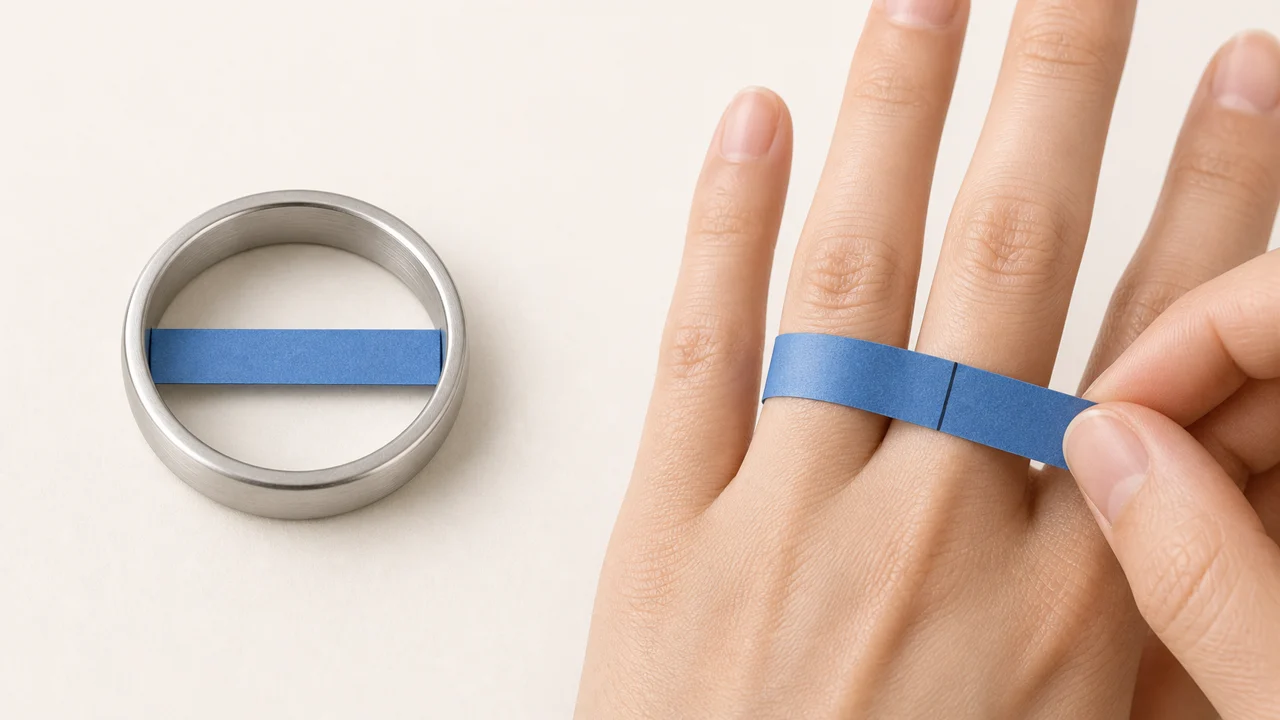
How to measure
Rings- Measure the inside diameter of a ring that fits.
- Or wrap a paper strip around the finger and measure the overlap.
- Repeat when hands are at normal temperature.
Your measurements
Closest reference
Enter the measurements you have. A partial result is okay, but more fields give a better match.
Reference only. Product cut, ease, width, material, and brand rules can change the final size.Measurement details
Ring size is best checked by millimeters. Use either a ring that fits or the finger circumference.
Wrap a strip of paper or soft tape around the finger, mark the meeting point, and measure the length flat.
The strip should pass over the knuckle without feeling loose.Measure when hands are at a normal temperature. Cold fingers can read small; warm or swollen fingers can read large.
Repeat a few times and compare the average.Wide rings and ring stacks feel tighter than narrow bands.
If you are between sizes, the larger size is usually safer.Ring calculator
Find the closest ring size
Enter an inside diameter or inside circumference in millimeters. The calculator compares your measurement with a shared ring size reference table.
Measure the inside opening, not the outside edge of the ring.
Closest matchUS 7
UK N 1/2 · ISO/EU 54 · JP 14 · CN 14
Inside diameter 17.3 mm · Inside circumference 54.4 mm · Difference 0.0 mm
Measure Before You Calculate
The calculator works best when the input is a real inside diameter or inside circumference measurement. Use a rigid ruler or caliper for a ring you already own, or wrap a paper strip around the finger and mark the overlap. Do not include paper thickness or outside ring diameter, because ring size charts are based on the inside opening.
Diameter vs Circumference
Diameter measures the straight line across the inside of the ring, while circumference measures the full inner path around the finger. Both can work, but diameter is often easier when measuring an existing ring and circumference is often easier when measuring a finger. The calculator converts either input to the nearest row in the same ring size table.
How Close Is Close Enough?
Small millimeter differences matter in ring sizing. If the nearest match is very close, use that row as a useful shopping reference. If the measurement falls almost exactly between two sizes, consider ring width, knuckle size, climate, and return policy before choosing. Half sizes can make a meaningful difference for daily-wear rings.
Use Cases for Sellers
Jewelry sellers can use this calculator as a support link when customers send a diameter or circumference measurement instead of a formal ring size. It gives a consistent conversion reference, reduces back-and-forth messages, and helps the seller remind buyers that brand-specific size confirmation is still important before ordering.
Best Inputs for the Ring Size Calculator
The calculator is strongest when the input comes from an actual inside measurement. For an existing ring, measure the open space inside the band, not the metal edge. For a finger, wrap paper or flexible tape around the exact finger and mark the overlap. Enter millimeters whenever possible because small inch fractions can create rounding errors. If you measure twice and get different values, use the average rather than the largest single reading.
When the Calculator Should Not Decide Alone
A calculated ring size is a starting point, not a final jeweler fitting. Wide comfort-fit bands, large knuckles, stacked rings, and temperature-sensitive fingers can all change the best size. For high-value jewelry, use this calculator to narrow the range before asking the seller about exchange rules or professional resizing. It is especially useful for online browsing, but a physical gauge is still better before a permanent purchase.
Related Size Tools
Continue with closely related tools instead of jumping through an unrelated directory.
Ring Size Chart
Best for matching an existing ring measurement to international size labels.
Ring Size Converter
Best for comparing international jewelry listings that use different regional labels.
Printable Ring Size Chart
Best for at-home measuring when a physical ring gauge is not available.
Shoe Size Converter
Best for cross-border shoe shopping where a store uses unfamiliar labels.
FAQ
Can I calculate ring size from diameter?
Yes. Enter the inside diameter in millimeters and the calculator will show the closest chart row.
Can I calculate ring size from circumference?
Yes. Enter the inside circumference in millimeters if you measured around the finger.
What if my result is between two sizes?
Compare the ring width and seller return policy. Wide bands may need the larger option.
Does the calculator guarantee a perfect fit?
Use the result as a sizing reference, then check the brand or seller chart before buying. Materials, fit preference, country labels, and manufacturing tolerances can change the best choice.